
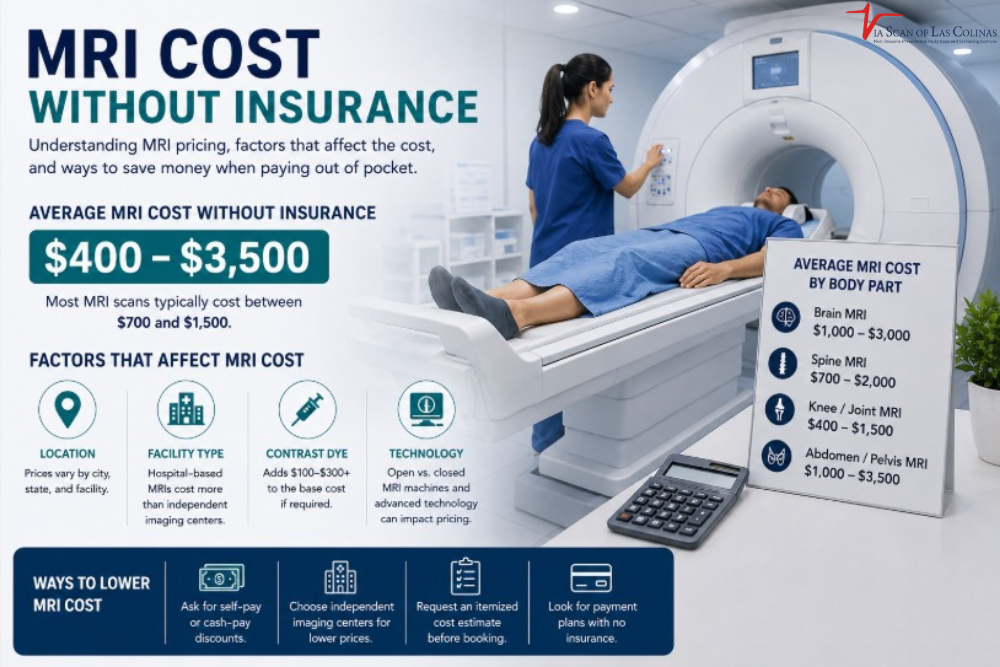

A non-insured MRI scan can range from $400 to $3,500, depending on the part of the body being scanned, the type of MRI you need, and whether you require contrast dye. Understanding how these factors affect the price of an MRI can help you make the smartest, most cost-efficient choice. One of the most flexible, cost-sensitive aspects of healthcare is medical imaging, and oftentimes, uninsured patients with no knowledge of how to ask for a self-pay price end up paying much more than what they should. This blog explains the average MRI scan cost, how they can be influenced by the price and what options are available for those who are paying it out of their own pocket.
What is the cost of an MRI scan without Insurance?
Without insurance, the average MRI scan ranges from $400 to $3,500; most MRI scans at typical MRI facilities cost between $700 and $1,500. Independent imaging centers or radiology practices will often be much cheaper than hospital imaging centers for the same imaging procedure. One of the largest cost factors is the body part being scanned, with the cost of an MRI of the brain being different from an MRI of the spine or abdomen, even on the same machine at the same facility.
Average costs for each type of scan.
Costs of the average MRI scan vary greatly depending on the area of the body being scanned. The standard price tag of a brain MRI is $1,000 to $3,000 on the hospital machine. Spine MRIs run $700 to $2,000. MRIs for knees and joints tend to be less expensive, anywhere from $400 to $1,500. MRIs of the abdomen and pelvis are often one of the more expensive types of MRIs because of the complexity of imaging and the longer time that they take.
What are the factors that Impact the price of an MRI without insurance?
There are a number of factors that contribute to the price of an MRI beyond the part of the body being scanned. By knowing these variables, uninsured patients can better inform themselves and ask the appropriate questions before making a decision on where to go or when to have a scan.
Location, Facility, Contrast Dye, and Technology.
- The largest cost driver is where the MRI is located: Hospital-based MRI scanners consistently cost 2 to 3 times more than independent outpatient imaging centers — even for the same MRI technology and the same radiologist interpreting the images.
- Location plays a big role in pricing — the MRI cost in high-cost-of-living states and larger metros is likely to be more expensive than the same MRI in smaller markets and in rural MRI facilities with lower overhead.
- The cost of certain conditions, including contrast dye, which is injected into the bloodstream to make the scan more clearly visible, is another $100-$300 or more that adds to the base cost of the scan, and depending on what the doctor wishes to determine, not all MRIs will require the addition of contrast dye.
- The distinction between open and closed MRI machines is also related to price, because some open machines are wider and less claustrophobic, and may be less available causing this to increase the price; and high-field closed machines at academic centers may be more costly because of the advanced technology and the longer scan time.
How can they lower the price of an MRI for Patients who don’t have insurance?
There are more answers to this question than you might think and the price of the same scan can vary significantly depending on the right questions asked at the beginning.
Self Pay Discounts, Payment Plans and Imaging Centers
- Be sure to request self-pay or cash-pay pricing before scheduling an appointment; many facilities will provide a discount to uninsured patients that pay at the time of service as opposed to through an insurance company, sometimes 30% to 50% off the “standard” price.
- Avoid hospitals — the most convenient place to begin looking for MRI payment plans with no insurance options is with independent imaging centers, who have been known to consistently provide the lowest prices for the same diagnostic quality as any hospital.
- Ask for an itemized cost estimate in writing prior to appointment, to prevent surprise billing and provide a comparison of costs and dates of scans before choosing a facility and date.
- There are plenty of MRI payment plans that do not require any insurance. Many imaging centers and hospitals have interest free or low interest payment plans that patients with no insurance can use to pay for the total expense over several months without having to pay it at once when he or she receives services.
Should an MRI always be done; are there other Imaging Tests that can be done?
An MRI doesn’t necessarily have to be the first or only test that is considered and in many cases, another test can provide the same diagnostic information for a much lower cost. Comparing the cost of a diagnostic test may assist patients and providers in making the best decision for the clinical situation.
In cases where CT Scans, X-Rays, and Ultrasounds may be recommended.
- Diagnostic test cost comparison revealed that CT scans usually cost less than MRIs, and are often the preferred option for bone injuries, conditions of the chest, and abdominal emergencies.
- The least expensive first line of examination of bones and lungs is x-ray.
- Ultrasound is an economical method for the assessment of soft tissue and organs.
- MRI is still the imaging modality of choice for detailed evaluation of soft tissue of the brain, spine and joints where other modalities are inadequate.
For anyone seeking any option for non-emergency imaging services, ViaScan of Las Colinas has a variety of non-invasive preventive imaging options available, including CT scans, whole-body scans and bone density scans, all offering meaningful health visibility beyond the walls of a traditional hospital. These services can be provided to those who are interested in understanding their health condition before it happens and are especially relevant to those who are responsible for out-of-pocket imaging costs and don’t have coverage from their insurance.
Choose Our Full Body Scan
Early Detection Saves Lives!
-
- Accurate
- Quick Result
- Affordable

Conclusion
While MRI price without insurance may seem unavoidable, there are ways to find a price that’s within reach and to get an estimate before heading to the doctor. The average MRI scan cost is much higher than many people realize, but there are ways to make the procedure more accessible, such as independent imaging centers, self-pay discounts, and MRI payment plans with no insurance. Don’t simply settle for the most expensive facility in the vicinity; seek professional advice on which test is appropriate in their case, and discuss all options before doing so. Consider visiting ViaScan, a dedicated preventive imaging center, for a scan or imaging services because they are sometimes more affordable than alternative imaging types performed at a hospital, at least on the front end.