
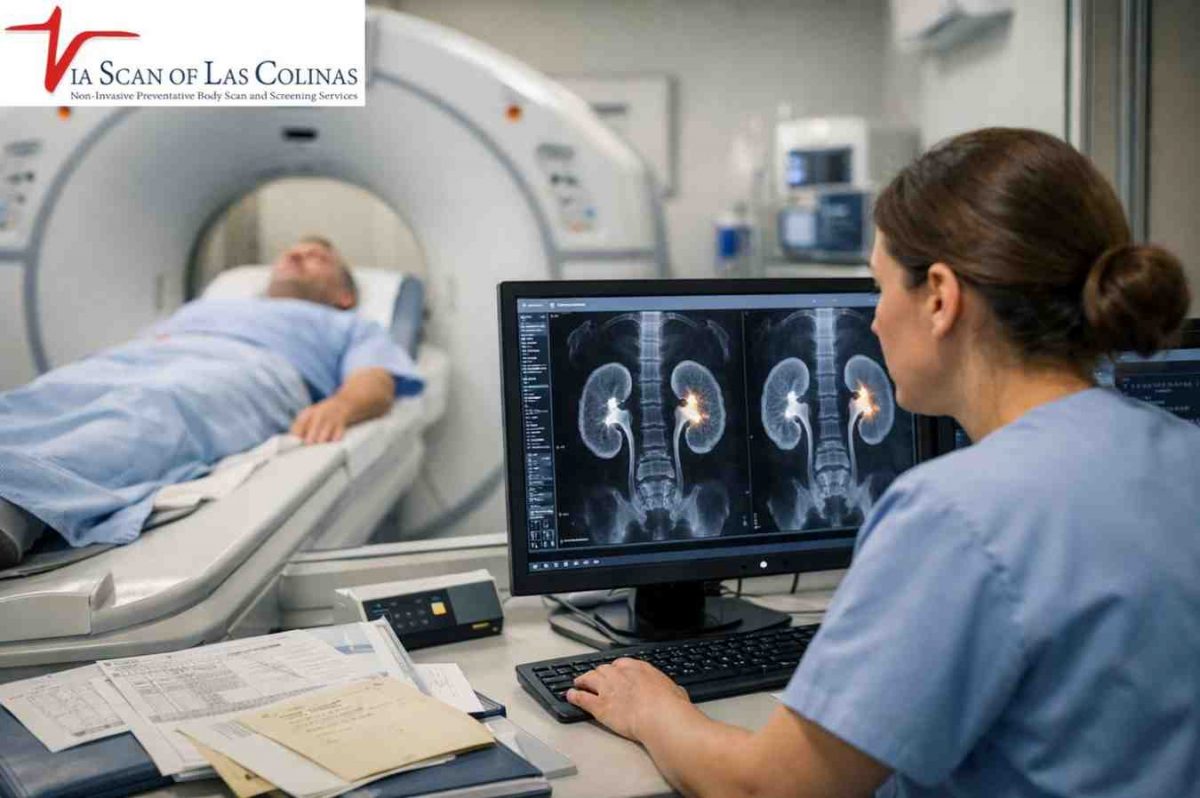

The acute, intense pain in the back or side is scary. These are the symptoms of kidney stones, and millions of individuals experience such symptoms every year. The only way to get some relief is to know the cause of the pain. Once the symptoms of kidney stones are observed, the correct diagnosis is essential. CT scans show the clearest, most detailed images of kidney stones that aid doctors in knowing precisely what is happening in your urinary tract. For residents of Irving, TX experiencing these symptoms, ViaScan offers high-quality CT scanning technology that identifies kidney stones in a fast and accurate manner.
What is the accurate diagnosis of kidney stones by a CT scan?
The CT scans involve the use of special X-rays to produce detailed cross-sectional images of your kidneys, ureters, and bladder. A CT scan can be used to rapidly determine the presence of kidney stones and their location when such kidney stone symptoms, such as:
- intense pain
- bloody urine
- or a challenging urine stream, are present.
The visual scan helps to identify the size and form of the stones and their location in your urinary tract. The CT scans are also able to detect almost all kinds of kidney stones, irrespective of their composition, unlike other tests. The CT scan services of ViaScan in Irving are the best scan services, which can give a result of high-quality images and help in identifying signs of kidney stones with great clarity, providing you and your healthcare provider with information that can be used to take the right action.
The CT Imaging Process of Stone Detection
CT technology operates on the principle of capturing various X-ray images from several angles around your body. A computer uses these images to give you detailed cross-sectional images of your inside organs. The presence of kidney stones is evident in a bright white spot when observed on the CT scan, since it is denser than the surrounding tissue. The scan is able to detect stones that are as small as 1-2 millimeters that other imaging methods may not be able to detect. The whole urinary tract can be seen, and it is possible to monitor the location of stones and define any obstacles and complications.
Precision, in addition to the Other Tests
- Compared to other imaging techniques, CT scans will identify 95-98% of kidney stones.
- Ultrasound identifies about 60-70% of the stones, but not all the small ones.
- X-rays detect only an approximation of 50-60% of the stones, leaving some types of rocks undetected.
- MRI is rarely used to examine kidney stones due to cost and less effective visualization.
- CT is the most detailed in terms of stone size, location, and complications.
Why is a CT scan the gold standard in the detection of kidney stones?
CT scans are now the imaging of choice in diagnosing the symptoms of kidney stones since they offer the best detail and accuracy. The technology identifies all types of stones, which are sometimes not detectable in normal X-rays, and their sizes as well. CT scans not only show the stones but also complications such as blockages, infections, kidney swelling, etc. CT is best suited to patients in extreme pain because its speed scan is typically less than 10 minutes. The technology of ViaScan with the high-quality CT scan will also give accurate imaging that licensed radiologists will need to make an accurate assessment to help the residents of Irving get a clear answer to whether they have signs of kidney stones.
Stone detecting capability and position
- Determines the presence of stones all over the urinary tract, starting with the kidneys and extending to the bladder.
- Detects the size of exact stones, which assists in forecasting whether some stones are going to pass naturally or not.
- Demonstrates the position of the stone as compared to other structures, such as blood vessels.
- Discloses several stones simultaneously that can be in existence.
- Identifies the presence of stones in unusual places that are not detected by other tests.
- Gives 3-dimensional images of a relationship of stones to the surrounding anatomy.
What kind of CT scan will be performed on kidney stones, and do you need contrast?
When the symptoms of kidney stones are involved, the doctor usually orders a non-contrast CT scan, which does not imply the administration of dye. It is a special scan that specifically detects the presence of stones and does not need any preparation or contrast medium. Computerized tomography Non-contrast CT is safer, quicker, and more comfortable than contrast studies. The lack of contrast avoids dye issues of allergy or renal problems. But when the doctors assume that you may have other conditions other than kidney stones causing your kidney stone symptoms, then contrast can be added. Through CT scan services offered by ViaScan, both non-contrast and contrast scan services are provided, and the required imaging approach, according to the needs of a particular patient, is determined by the licensed professionals.
Non-Contrast CT Explained
Kidney stone CT is a very effective method, fast, and uncomplicated. The scan is finished in less than 5-10 minutes. The procedure does not need any IV line or injection, thus being entirely painless besides lying down on the scanning table. It is possible to have a normal pre-test meal and drink. None of the medication or special preparation is required. No contrast material means there is an instant result without holding on to await the circulation or clearance of dye in your system.
Where Contrast May Be Possible.
- Suspected infection or abscess as well as kidney stones.
- Should check the blood flow or kidneys.
- Kidney stone symptoms that do not have a clear cause could be other than stones.
- Evaluation of complicated anatomical differences.
- Previous surgical procedures or anatomical abnormalities that involve advanced imaging.
- Where more diagnostic information would help in making a medical decision.
What do patients anticipate in having a CT scan to identify kidney stones?
Upon visiting ViaScan to attain a CT scan to assess the kidney stones, the procedure is very simple and painless. You will be requested to put on a medical gown and remove any metal items that can disrupt imaging. The technologist puts you on the scanning table, which is normally on your back. The table is inserted into the CT scanner, resembling a huge donut. The machine has some humming and clicking sounds. An entire scan only requires 5-10 minutes. And then, licensed radiologists access your images and give detailed reports of such signs of kidney stones found during the scan.
Step-by-Step Scan Process
- Register and sign paperwork forms.
- Undress and put on a medical gown and tie up personal possessions.
- Place your position on the cushioned scanning table.
- The table passes rather slowly through the CT scanner.
- The scanning takes between 5 and 10 minutes.
- Reports are usually available within 24-48 hours.
Choose Our Preventive CT Scan
Early Detection Saves Lives!
-
- Accurate
- Quick Result
- Affordable

Conclusion
The proper diagnosis in case of the symptoms of a kidney stone presupposes the selection of high-quality imaging equipment and qualified specialists. ViaScan, located in Irving, TX, deals with the high-level CT scan services that help state the existence of kidney stones with unparalleled precision. We have state-of-the-art imaging devices and experienced radiologists who offer the overall examination you require whenever you get positive indications of kidney stones. We also provide complete health scans and preventive scans with the help of a whole body scan.